
Faith
Trusting in God's character and promises, even when circumstances are uncertain. Students learn to anchor their lives in the faithfulness of God.
“Now faith is the assurance of things hoped for, the conviction of things not seen.”
Hebrews 11:1
Rooted in faith. Grounded in truth. Devoted to the formation of the whole person.
Heartland Classical Academy exists to partner with Christian families in forming young people who love God, pursue truth, and serve others faithfully through rigorous classical education rooted in Scripture, cultivating wisdom, moral courage, academic excellence, and responsibility toward families, churches, and communities.
To develop faithful Christians, life-long learners, and virtuous citizens who impact future generations for the glory of God.
The convictions that shape everything we do at Heartland Classical Academy.
Jesus Christ is Lord over all creation and every area of life. Our school exists to glorify Him and point students to the Gospel in all things.
We are called not merely to educate, but to disciple. Teachers model Christ-like character and invest personally in the spiritual formation of each student.
The Bible is the inspired, inerrant Word of God and the ultimate authority for faith and practice. Scripture shapes our curriculum, our culture, and our community.
We draw from the rich heritage of classical Christian education — a tradition spanning centuries that has formed some of history's greatest thinkers, leaders, and servants.
True education cultivates the whole person — mind, heart, and hands. We pursue intellectual rigor, moral formation, and practical wisdom in equal measure.
Our teachers are guides and mentors who lead with expertise and passion, while students are expected to engage actively, ask questions, and take ownership of their learning.
Parents are the primary educators of their children. Our school exists to come alongside families, supporting and extending the work that begins in the home.
What sets a classical education apart from conventional approaches.
A deep introduction to the Western Intellectual Tradition
Foundational literacy and numeracy skills
Content-rich, integrated study across disciplines
Latin study beginning in 6th grade
A commitment to objective standards of goodness, truth, and beauty
A focus on moral virtue
Teacher-led instruction with minimal technology
Classical Christian education addresses the deepest questions students naturally ask: Who am I? Why am I here? What is true, good, and beautiful? Rather than treating faith and reason as adversaries, we hold that all truth is God's truth. The classical tradition — rooted in the liberal arts, great books, and the pursuit of wisdom — finds its fullest expression when grounded in the Christian faith. Together, faith and reason form students who can think clearly, communicate persuasively, and live virtuously.
Education is the process of transforming understanding through encounter with God's revealed truth. It is not merely the transfer of information but the cultivation of wisdom, character, and calling. At Heartland Classical Academy, we believe that every child is made in the image of God and therefore possesses inherent dignity, capacity for reason, and a calling to steward God's creation. Our task as educators is to guide students into deeper knowledge of God, themselves, and the world — equipping them to live faithfully under Christ's lordship in every sphere of life.
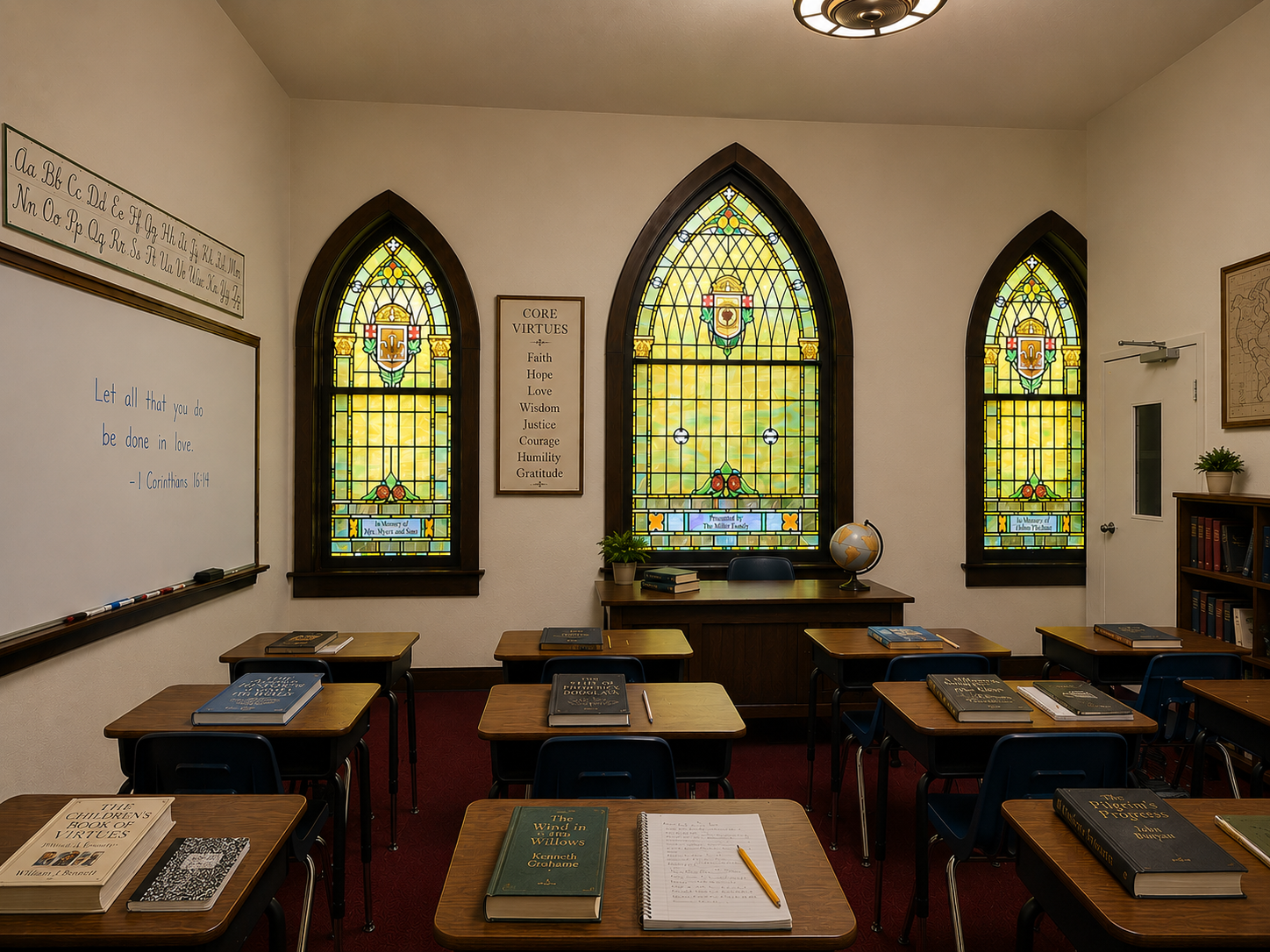
The character qualities we cultivate in every student through word, example, and practice.
Trusting in God's character and promises, even when circumstances are uncertain. Students learn to anchor their lives in the faithfulness of God.
“Now faith is the assurance of things hoped for, the conviction of things not seen.”
Hebrews 11:1
Confident expectation rooted in God's sovereignty and goodness. Students cultivate a forward-looking optimism grounded not in circumstances but in Christ.
“May the God of hope fill you with all joy and peace in believing.”
Romans 15:13
Self-giving care for God and neighbor that mirrors Christ's sacrifice. Students practice love through service, kindness, and genuine concern for others.
“A new commandment I give to you, that you love one another: just as I have loved you.”
John 13:34
The ability to discern what is true, right, and lasting. Students pursue wisdom as the highest aim of education — knowing not just facts, but how to live well.
“The fear of the Lord is the beginning of wisdom.”
Proverbs 9:10
A commitment to what is right and fair, reflecting God's own character. Students learn to stand for truth and advocate for those who cannot advocate for themselves.
“He has told you, O man, what is good; and what does the Lord require of you but to do justice, and to love kindness, and to walk humbly with your God?”
Micah 6:8
The strength to do what is right even when it is difficult or costly. Students are encouraged to stand firm in conviction and act boldly for the good.
“Be strong and courageous. Do not be frightened, and do not be dismayed, for the Lord your God is with you wherever you go.”
Joshua 1:9
A right understanding of oneself before God — neither inflated nor diminished. Students learn that true greatness comes through service, not self-promotion.
“Do nothing from selfish ambition or conceit, but in humility count others more significant than yourselves.”
Philippians 2:3
A heart of thankfulness that recognizes every good gift as coming from God. Students cultivate habits of gratitude that shape their outlook on life.
“Give thanks in all circumstances; for this is the will of God in Christ Jesus for you.”
1 Thessalonians 5:18